Library — Deployment and control
Sovereign by design
An intelligence layer sees the whole operation. That makes where it runs, who can reach it and what leaves it questions to settle before anything else.
01The problem
The more a system understands about an operation, the more it matters who controls it.
An intelligence layer holds the dependencies, the weak points, the exposure and the decisions — precisely the picture an organisation would least want to leak, or lose control of. For operations where that picture is itself critical, the architecture has to begin from control rather than add it later.
That means knowing where the system runs, whose services sit in its request path, who inside the organisation can see what, and how every change and every answer can be traced back.
The model of an operation is only as trustworthy as the boundaries it keeps.
02How it plays out
A supply chain director asks Scio a direct question: which of our sites are most exposed if a single supplier fails?
An illustrative sequence, not a customer account.
Where the question goes
It is answered from the organisation’s own computed intelligence, inside its disclosed deployment region. Neither the question nor the answer is sent to a third-party model or service.
Who sees what
The director sees the full answer, because their role covers every site. A site manager asking the same question sees only their own site. The same permissions govern the conversation, the reasoning and the dashboards, because they are applied to the underlying objects rather than to each screen.
How it can be checked
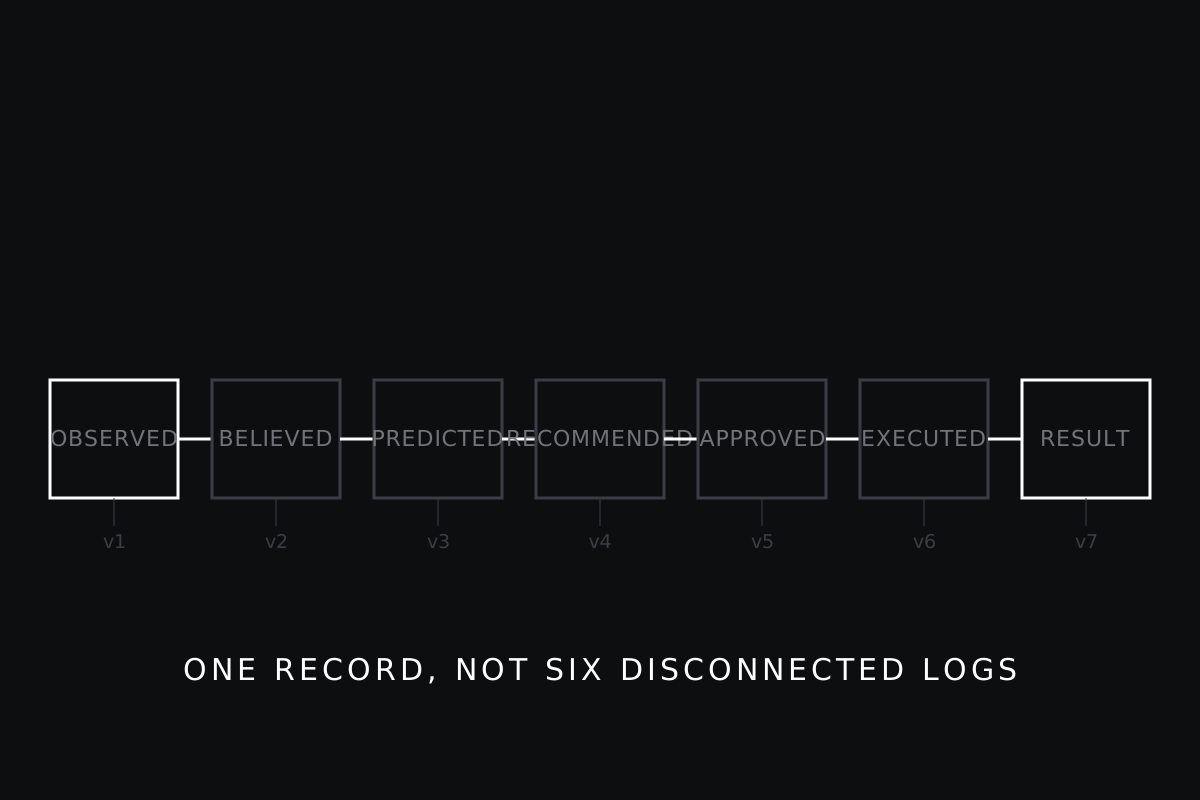
The answer cites the objects and relationships it was drawn from, with their sources and their confidence. If an auditor later asks why a decision was taken on it, the network can be reconstructed exactly as it stood when the question was asked.
What cannot happen
Nobody can quietly alter the history behind it. Every change to the model is held in a tamper-evident record, attributed to the person or source that made it.
Control was not added to this sequence afterwards. It is the shape the sequence had to take from the start.
In your environment
We'd run it where your data already lives.
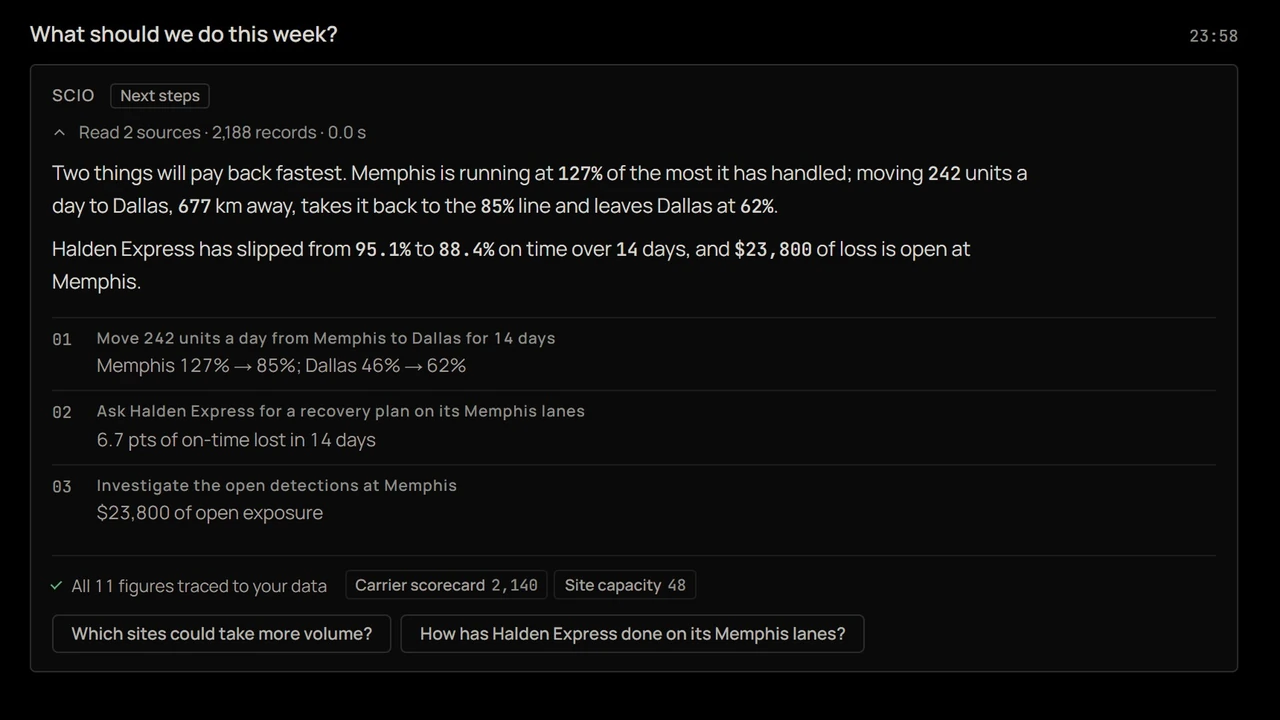
Your model is held in strict isolation, in a region named before any data moves. Scio answers from it without sending anything to an outside model, and every answer stays on record.
- No external model calls
- Access scoped per person
- A record that cannot quietly change
A screen from Scio, on synthetic data.
03What that means in practice
- 01
Strict isolation
Every organisation’s model is private and persistent — never shared, blended or inferred from anyone else’s data.
- 02
No external model calls
Scio answers from the organisation’s own computed intelligence rather than sending its data to a third-party model.
- 03
Mapping hosted in-house
Geography is rendered on mapping infrastructure Theralon builds and hosts itself, with no third-party service in the request path.
- 04
A disclosed deployment region
Region is an explicit, first-class setting — and the platform warns rather than guesses when it has not been set.
- 05
Access scoped per person
What each person can see across the model, the risk register and compliance data is enforced centrally, not left to each screen.
- 06
A record that cannot quietly change
Every change to the model, a risk item or a model version is held in one tamper-evident history.
04What changes
Controls added around the product
Controls built into the model
Data sent out to be understood
Understanding computed in place
Audit reconstructed from memory
Audit answered from the record
05Under the hood
Permissions apply to the underlying operational objects and relationships, so the same controls govern dashboards, reasoning, conversational access, reports and actions. The whole network can be reconstructed exactly as it stood at any past moment.
Two questions
- Could you ask your systems which sites are most exposed, without your data leaving your environment?
- Could you show an auditor exactly who saw what, and when?
Theralon does both. See it on your own operation.
Show us where the operation breaks down. We build around your data, your systems and how you actually operate, at whatever size the operation is. Then compare it with what you run today.
There's no cost while we work with you, for the foreseeable future. You see what the software does on your own operation before it costs you anything.
When it has shown its value there, we agree terms with you, sized to what you run, and nothing becomes a contract until you agree to it.