Platform — From signal to governance
Risk protection
Know which problems actually cost you money.
Not a feed of alerts: one register of what the operation is exposed to, who owns each item, what it is worth and whether it is covered. Every figure traces back to the loads, customers and records it came from, so it holds up in front of an owner, an insurer or a customer’s audit.
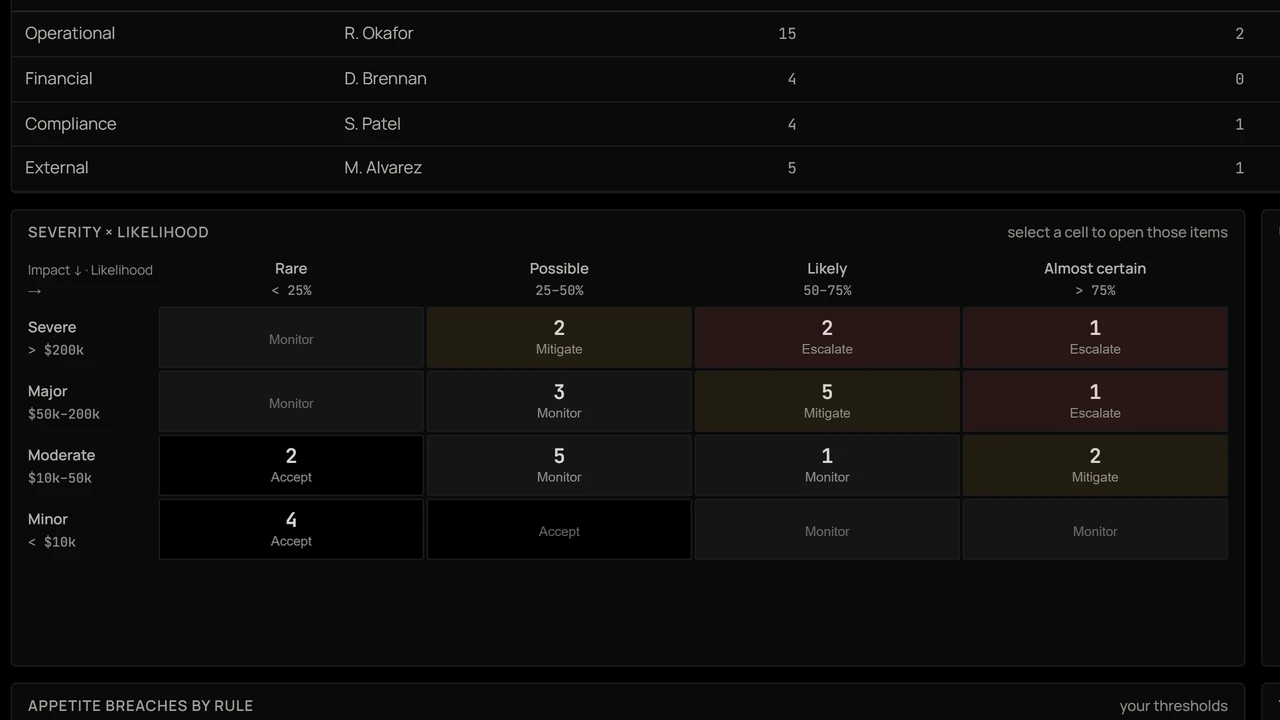
Vigil's severity and likelihood matrix, with exposure across the register. A screen from Vigil, on synthetic data.
What it gives you
Risk that holds up in front of the people who ask.
- 01
A register, not a feed.
Every item categorised, owned, and attributed as its status changes.
- 02
Figures you can defend.
Severity and likelihood computed from real exposure, with the evidence disclosed.
- 03
One cause, counted once.
Exposure behind a single shared dependency identified as such.
- 04
Your own tolerance, enforced.
A breach records exactly which rule was crossed and by how much.
Five principles
How the register is kept.
- 01
Keep a register, not a feed.
Items persist and are categorised by type — operational, financial, compliance, external — because each has a different owner in a real organisation. Every status change is attributed to a person and timestamped.
- 02
Compute severity and likelihood, don't guess them.
Impact is calculated from real exposure where it's knowable, and left honestly blank where it isn't — never double-counted across categories. Every likelihood figure discloses the evidence it rests on.
- 03
Make concentration and coverage visible.
Surface where a critical share of activity depends on a single partner or resource with no alternative in place, and split every exposure figure into covered, retained, and unknown. Three separate hub-concentration items are often one common cause wearing three hats, and are counted once.
- 04
Hold the organisation to its own tolerance.
Every operation defines its own thresholds — maximum exposure, maximum concentration, maximum uninsured risk. A breach records exactly which rule was crossed and by how much.
- 05
Escalate and report without reformatting.
Items that cross a threshold route automatically to their owner. The register exports as a board- or auditor-ready report exactly as it appears live.
Detection tells you something is wrong. Governance tells you who owns it, what it's worth, whether it's covered, and whether the organisation is honouring its own tolerance for it.
Go further
Where the register gets its signals, and where it goes.
Two questions
- Can you trace the number you have for margin at risk this month back to the loads and customers it came from?
- When your team makes a call on it, is there a record of why that can't quietly change later?
Vigil does both. See it on your own operation.
Show us where the operation breaks down. We build around your data, your systems and how you actually operate, at whatever size the operation is. Then compare it with what you run today.
There's no cost while we work with you, for the foreseeable future. You see what the software does on your own operation before it costs you anything.
When it has shown its value there, we agree terms with you, sized to what you run, and nothing becomes a contract until you agree to it.