Library — Product overview
The system of understanding
The full account of what Theralon is: the model underneath it, the loop that reasons over it, how confidence is made interrogable, and what it is built to do with all of it.
- 6
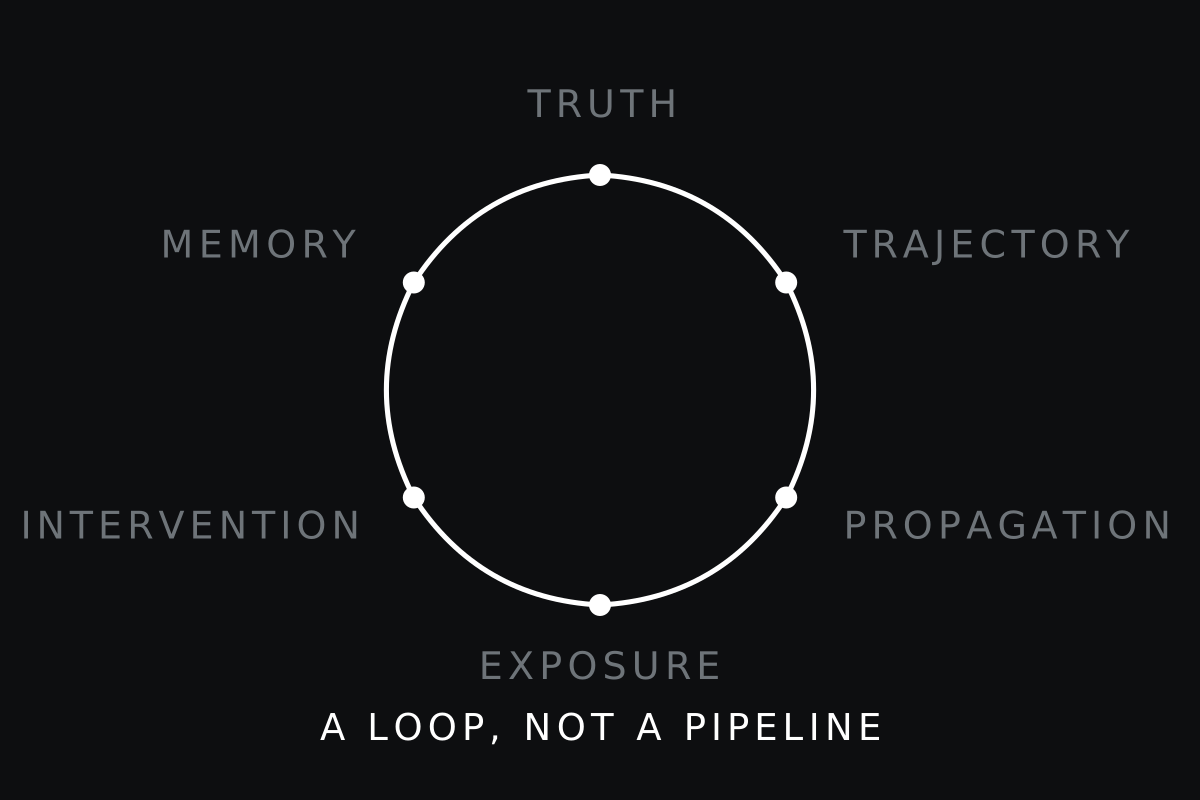
- Reasoning stages, run as one loop rather than as independent analytics: truth, trajectory, propagation, exposure, intervention, memory.
- 47 → 11
- Observed risk conditions consolidating into the underlying exposure concentrations they actually represent.
- 0
- Systems of record replaced. Theralon reads ERP, EAM, MES, WMS, TMS, CMMS, SCADA and live telemetry where they already are.
01Enterprise software records operations. Theralon understands them.
For decades, enterprise software has focused on recording what happened. Transactions. Sensor readings. Maintenance records. Production output. Fleet locations. Customer orders. Operational history.
This information is valuable, but history alone does not improve operations. Dashboards provide visibility. Reports measure performance. Alerts notify operators after predefined thresholds have already been exceeded. By the time most organisations know a problem exists, the opportunity to prevent it has often passed.
Visibility is no longer the challenge. Decision-making is. Enterprises can already see more than ever; what they still lack is a system capable of converting that visibility into a coherent understanding of what matters, what is changing, what is connected, and what action will produce the best outcome.
Theralon transforms operational data into operational intelligence. It continuously analyses how assets, infrastructure, people, resources and processes interact, identifies emerging patterns long before they become visible to operators and recommends the actions most likely to improve business outcomes.
Instead of asking: *"What happened?"* Theralon answers: *What is happening? Why is it happening? What is likely to happen next? What should we do now?*
Those are fundamentally different questions. They require fundamentally different software — software that does not stop at reporting the present, but continuously reasons over the operation, projects consequences into the future and connects every recommendation to the evidence that produced it.
02One enterprise. One operational model.
Every enterprise is more connected than its software suggests. A delayed shipment affects manufacturing. Manufacturing affects inventory. Inventory affects customer delivery. Equipment reliability affects production capacity. Weather affects logistics. Energy prices affect operating costs. A maintenance decision influences the performance of an entire production network.
Existing software understands each of these events independently. Theralon understands the relationships between them, the dependencies those relationships create, the constraints that sit behind them and the consequences that emerge when one part of the network changes. That distinction is the foundation of the platform: not more individual facts, but a system capable of understanding how those facts interact.
At the core of the platform is a living Principia — Theralon’s continuously updated representation of the enterprise and the operational reality inside it. It is not simply a database, a data catalogue or a visual network graph. It is a structured world model containing the entities that matter — carriers, hubs, facilities, shipments, assets, orders, resources and other operational objects — together with the relationships, dependencies, measures, history and state that give those entities meaning. The Principia is built from every operational system already in use: ERP, EAM, MES, WMS, TMS, CMMS, SCADA, industrial IoT platforms, operational databases, cloud data platforms, streaming infrastructure, EDI interchanges, APIs and live telemetry. Theralon parses real X12/EDIFACT EDI traffic and reconciles ASN against receipt data automatically, so the model reflects what actually moved, not just what was planned. It continuously absorbs new observations, reconciles competing signals and carries the current state forward as the operation changes. The result is a living operational model against which Theralon can reason — not a static representation of yesterday’s data, but the foundation for understanding what is happening now and what that means next.
The Principia is not a read-only mirror of source systems. It has a governed write path: new entities and relationships can be added directly, each one validated, attributed to its source, and versioned — so the model can be corrected or extended by an operator, not only by pipeline ingestion, while still being able to prove where every fact came from. This matters because the operational model cannot remain trapped by what the source systems happen to contain. Reality changes faster than schemas do. New dependencies appear, organisations change, assets are reconfigured, and operators know things that no upstream system has captured yet. The Principia can therefore be extended without sacrificing governance, provenance or structural integrity.
Every organisation's operational model is held in strict tenant isolation — a private, persistent, continuously updated representation of that enterprise alone, never shared, blended or inferred from another organisation's data. Access within an organisation is itself scoped: what a given principal can see across risk items, compliance data and the Principia is enforced centrally, not left to each view to reimplement. The result is that the same model that powers analysis, simulation, recommendations and conversational access also respects the boundaries under which the organisation operates. The intelligence layer is shared across the enterprise only to the extent the enterprise itself authorises it.
The result is not more data. It is a living operational understanding: what exists, how it is connected, what state it is in, how that state is changing, what is exposed, what is likely to happen next and where intervention can change the outcome. That is what makes everything else in Theralon possible.
03A model that understands structure, not just status
Most operational software answers one question well: where is this, right now. A shipment's location. A machine's uptime. A carrier's on-time percentage. Each fact sits by itself, current and accurate, and disconnected from everything around it. That is tracking. It is useful, but it is not understanding. Understanding begins when the platform knows what the fact is connected to, why the connection matters, how the condition is changing, and what consequences follow when that condition moves in one direction or another.
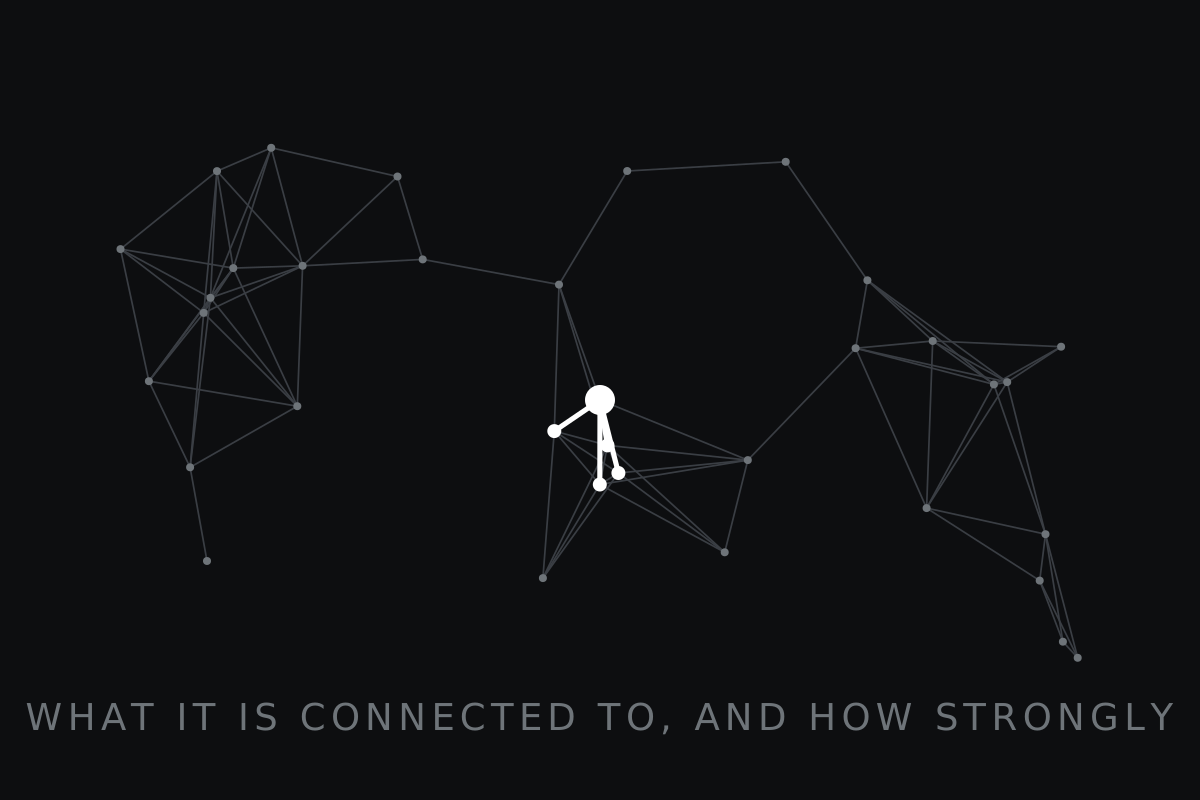
This is what Theralon's Principia is built to do. It is a graph, not a table: every carrier, hub, facility, shipment and asset is a node; every relationship between them — serves, ships-through, depends-on, supplied-by — is an edge with its own attributes, its own source, and its own history. A single fact rarely means anything alone. What matters is what it's connected to: which hub a delay actually routes through, which downstream facility absorbs it, which other partner shares that same exposure. A flat status feed cannot answer any of that, because it was never built to hold the relationships in the first place. A graph was.
It has a stated shape. Every entity type declares the properties it may carry — each with a type, a unit, whether it is required, and whether it was derived from ingested data or supplied by an operator. Every relationship is declared as a permitted triple, with cardinality and a readable inverse, so "what can even connect to a facility" is an answerable question rather than tribal knowledge. That schema is published, which makes the model self-describing to an integrator who was not in the room when it was designed. Critically, both the automated derivation path and the manual write path validate against the same definition — a schema only the untrusted side is checked against drifts from reality within a release or two, and then the published shape is a fiction. A misspelled property or a relationship pointing the wrong way round is refused with an explanation, never silently stored as a fact indistinguishable from a real one.
It can be traversed, not just filtered. The questions operations actually get asked are multi-hop: if this partner fails, what goes with it; how is this carrier connected to that hub at all; which single object is the network most structurally dependent on. Theralon answers those by walking an indexed graph, so blast radius and shared-dependency analysis are ordinary queries rather than bespoke reports.
It ranks what an object is really coupled to, and prices leaving it alone. A single facility can reach hundreds of other objects within a few hops — drawing all of them is a hairball, not a reading. Theralon surfaces only the strongest handful and states, in words, how strongly each one is coupled, on what measured basis, and what happens if that coupling is left unaddressed — the part a diagram can show but never say.
It joins structure to exposure. Because risk items attach to the entities that actually carry them, the platform can see what a flat register cannot: that three separate hub-concentration items are one common cause wearing three hats. Exposure sitting behind a single shared dependency is identified as such and counted once.
It remembers. Every materially-changed entity and relationship is snapshotted to an append-only log, and the whole network can be reconstructed as it stood at any past instant — not one object at a time, but the entire graph. An auditor reconstructing a decision, an insurer testing whether a policy covered the lane it was sold against, an incident review asking which facilities depended on the failed partner *that week* — all of them have a date, not a list of object IDs. This answers them.
It carries an operational reading, not just a shape. Structure alone produces the thing every Principia demo eventually becomes: an impressive spiderweb that is unreadable within ten seconds, because a dot tells you an object exists and nothing more. Every object in Theralon's graph carries how it is performing, which way it is heading, and how much strain each connection is under — and every score decomposes into the factors that produced it, deliberately transparent rather than learned and unexplainable.
It is never limited to a fixed field list. A source that carries columns nobody predefined — a dwell time, a fuel surcharge, a damage count, a temperature reading — is not dropped for not matching a known name. Theralon profiles it, classifies what kind of measure it is, attaches it to the object it describes, and reasons over it exactly as it would any built-in field. And a feed missing one required field is not discarded either: it is graded on what it *can* drive, so a source with no receipt data still populates the network and scores lanes, and a source with no carrier column still contributes its transit measurements. Nothing usable is thrown away for being incomplete by someone else's checklist.
And it is read for the operator, not dumped on them. Twenty accurate figures with no statement of which one matters is a data dump; the reader's real question — is there anything here I should act on — goes unanswered while surrounded by evidence. Theralon makes that judgement itself, returning a small, ranked set of findings stated in plain language, each one bound to the measurement behind it so it can always be unwound back to a stored figure. No finding is published without evidence, no threshold is invented (comparisons come from the organisation's own stated risk appetite or from the network's own distribution), and when nothing rises to a finding, the platform says so and names what it checked — because a panel that renders empty without saying it looked is indistinguishable from one that is broken.
All of it is rendered on real geography — facilities, carriers and lanes in the physical space they actually occupy — on mapping infrastructure Theralon builds and hosts itself, with no third-party service anywhere in the request path.
Visibility, however well executed, amounts to a very good list. Theralon is the map that list was always missing.
04From signals to decisions
Operational data only becomes valuable when relationships are understood. A number by itself describes a condition. Intelligence begins when that condition is placed inside the system that produced it — when Theralon can see what changed, what caused it, what else is affected, how quickly the consequence will travel and where intervention can still alter the result.
A small vibration increase on a compressor. A delayed inbound shipment. An unexpected weather event. An increase in warehouse congestion. A reduction in production throughput. Viewed independently, each can appear insignificant, especially when it remains within the tolerances of the system that recorded it. Viewed together, they can describe an emerging operational problem whose consequences are already moving through the enterprise.
Theralon continuously identifies these relationships across the enterprise. It does not wait for one signal to cross a static threshold before it becomes relevant. It evaluates signals in context: against historical behaviour, current operating conditions, connected entities, available capacity, dependencies, timing and the consequences already visible elsewhere in the network. A change that would be harmless in one part of the operation may be critical in another because the surrounding conditions are different. Theralon understands that difference because the condition is never evaluated in isolation from the Principia.
As conditions change, the operational model updates in real time. Machine learning models evaluate future outcomes. Risks are identified while they remain preventable. Constraints are recognised before they become bottlenecks. Resources can be reallocated before performance deteriorates. Emerging positive conditions are also identified: underused capacity, improving reliability, excess inventory, alternative routes or resources that could relieve pressure elsewhere. The same intelligence that identifies where the operation is becoming fragile can identify where it has room to respond.
This is the point at which operational intelligence becomes materially different from monitoring. Monitoring tells an operator that a metric moved. Theralon determines whether the movement matters, what it is connected to and what the organisation should expect if it continues. It can move from signal to explanation, from explanation to propagation, from propagation to exposure and from exposure to intervention without requiring the operator to reconstruct the chain manually.
The platform is therefore not waiting for an alert to become severe enough to justify attention. It is continuously evaluating the direction of the operation and the implications of that direction, giving decision-makers a chance to intervene while the outcome is still changeable. The earlier the system understands the trajectory and the wider the consequence it can see, the more options remain available.
Operational decisions become proactive rather than reactive. The objective is not simply to predict disruption. It is to prevent it — by identifying the conditions that lead to failure early enough, understanding what those conditions will propagate into, quantifying what is actually exposed, and selecting the intervention most likely to change the trajectory before the cost of inaction becomes unavoidable.
That is the transition Theralon is designed to make: from systems that report what happened, to intelligence that understands what is happening; from intelligence that explains what is happening, to intelligence that determines what happens next; and from knowing what could go wrong to changing the outcome while there is still time to do so.
05A closed reasoning loop, not a collection of features
Theralon doesn't just model the enterprise. It continuously reasons over its changing state.
That reasoning is not a set of independent analytics running side by side. It is a single loop, and each stage hands its work to the next:
Operational Truth. Large enterprises routinely hold several competing versions of the same reality. A shipment shows delivered in the ERP while the warehouse has not received it, the carrier says delayed, and telemetry shows the vehicle still on the road. Theralon establishes what is actually true — reconciling source precedence and reliability, staleness, delay, duplicate events, entity identity and temporal ordering. Critically, it does not overwrite the disagreement and pretend one system was simply wrong. It preserves the conflict and determines the most defensible current state. To the enterprise question "we have six systems that disagree, which should we believe?", Theralon is the reconciliation layer.
Trajectory. What direction is the operation moving, and is that movement meaningful?
Propagation. If this condition changes, what does it cause downstream? Not "Supplier A is connected to Plant B", but: Supplier A is deteriorating; Plant B depends on it for a component with a two-day buffer; Plant B's schedule will become constrained; those orders support customers C, D and E. Structural and operational dependency, timing, capacity to absorb, substitutability, redundancy, cascading bottlenecks and recovery — modelled together.
Exposure. Risk answers how likely and how severe. Exposure answers what that risk actually puts at stake — and consolidates it. Because the same underlying dependency surfaces through different business units, facilities and categories, the honest statement is rarely "47 high-risk items". It is: 47 observed risk conditions consolidate into 11 underlying exposure concentrations.
Intervention. What should we do about it — evaluated against the whole operational graph, because the best decision is frequently not the one with the biggest direct benefit. Expediting a shipment may reduce one risk while creating transport cost, warehouse congestion and a new bottleneck downstream.
Operational Memory. What actually happened, and what that means for the next decision.
Each stage transforms the enterprise's operational state rather than emitting a disconnected report, and each one enriches what came before rather than overwriting it — so the causal chain from a recommendation back to the source observations that produced it stays intact and inspectable.
Underneath the loop sit shared reasoning capabilities that any stage can call: forecasting, simulation, optimisation, machine learning, rules and causal inference. These are techniques, not stages. Forecasting matters because Trajectory, Propagation and Intervention use it — not as a destination in its own right.
The output of all this is not a report. It is a continuously better representation of reality.
06Confidence that can be interrogated
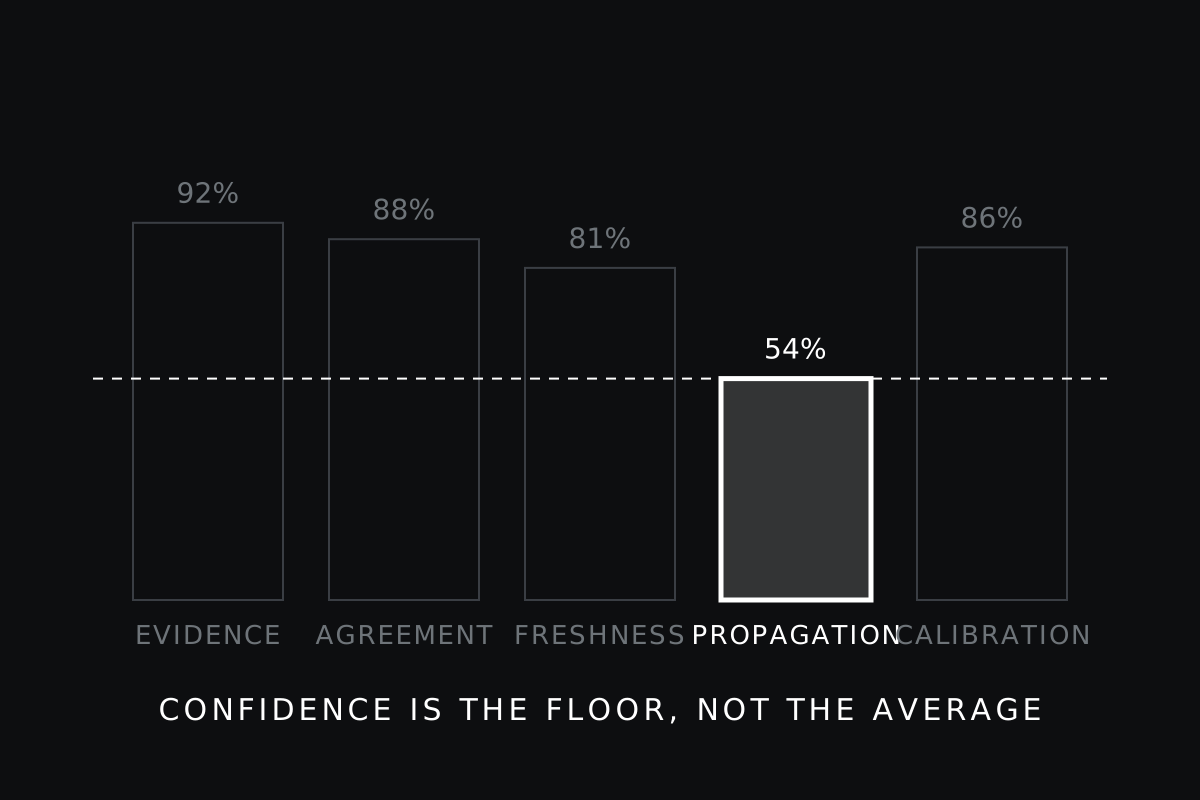
A single confidence score is easy to produce and almost impossible to trust. Theralon's confidence is a structure, not a number: evidence quality, source agreement and freshness beneath Truth; baseline and signal confidence beneath Trajectory; dependency, timing and substitutability beneath Propagation; valuation and impact beneath Exposure; feasibility, predicted outcome and historical effectiveness beneath Intervention.
These uncertainties are related to one another, so they are never simply summed. Some of them are floors rather than terms — an outstanding score in five dimensions does not compensate for a critical weakness in one. If alternative supplier capacity is essentially unobserved, no amount of data freshness elsewhere makes the conclusion sound. Confidence therefore reflects the weakest material part of the reasoning, not an attractive average of everything that went well.
That distinction matters because operational decisions are rarely made under perfect information. The useful question is not whether uncertainty exists. It is whether the uncertainty is understood, bounded and decision-relevant. Theralon distinguishes between conflicting evidence, stale evidence, missing evidence, weak calibration and uncertainty inherent in the future itself. It can show whether a conclusion is constrained because two sources disagree, because a critical dependency is only partially observed, because the historical baseline is weak, or because the predicted outcome has limited calibration in comparable situations.
What that buys is the ability to answer the only question that matters about a confidence figure — why that number, and where is the uncertainty. Confidence becomes something an operator can interrogate rather than a score they are expected to accept. Theralon can identify which component is limiting the conclusion, distinguish missing evidence from conflicting evidence, and show whether the weakness is likely to change the recommendation or merely narrow the range of possible outcomes:
Decision confidence: 72%. Primary limiting factor: propagation confidence, 54%. Cause: alternative supplier capacity is only partially observed.
An operator can then ask what would improve that confidence. Which source needs to be refreshed? Which relationship needs to be verified? Which capacity assumption is unsupported? Which additional observation would materially change the decision? Confidence becomes operationally useful because it points to the uncertainty that needs to be resolved, not merely the existence of uncertainty.
The same structure also prevents false precision from being hidden inside polished recommendations. A recommendation with high predicted effectiveness but poor evidence is not equivalent to a recommendation with high predicted effectiveness and strong evidence. A forecast built on a stable historical pattern is not equivalent to one built on a regime the enterprise has rarely experienced. Theralon keeps those distinctions visible so that decision-makers can judge not only the expected result, but how much trust should be placed in that expectation.
And because confidence carries provenance in the same way facts do, a recommendation can be traced back through exposure, propagation and trajectory to the individual operational claims and source observations beneath it. An operator can establish that a recommendation is weak because one specific fact came from a stale, low-reliability source — rather than being asked to accept a score.
This makes confidence part of the reasoning itself. The system does not claim certainty where none exists, and it does not allow strong evidence in one part of the chain to conceal a material weakness in another. When the evidence is insufficient, Theralon says so. When the uncertainty is material, it surfaces it. When the uncertainty is acceptable for the decision being considered, it shows why. Trust is not created by removing uncertainty from the interface. It is created by making uncertainty legible enough to act on.
07Intelligence only matters if it leads to action
Prediction is not the objective. Better decisions are. A prediction that arrives too late, cannot be explained, or does not change what the organisation does is little more than an interesting statistic. Theralon is designed to carry intelligence all the way to a decision that can be understood, challenged, approved and acted upon.
Every recommendation generated by Theralon is designed to be understood, trusted and acted upon. Each operational issue includes: what is happening, why it is happening, which signals contributed, the predicted operational impact, recommended actions, expected outcomes, and confidence in the recommendation. This creates a complete bridge from finding to decision: an operator can see not only the conclusion, but the operational facts behind it, the consequences Theralon expects, the alternatives it considered and the basis on which one action is preferred. The recommendation is therefore a decision object, not a sentence generated at the end of an analysis.
Theralon evaluates actions against the operation that will actually have to absorb them. A recommendation is not considered in isolation simply because it improves the metric that first drew attention. Expediting one shipment can increase transport cost and warehouse congestion. Moving inventory can reduce one exposure while increasing another. Increasing production can resolve a customer constraint while exhausting a shared resource. The platform therefore reasons through direct benefit, downstream effects, feasibility, reversibility, cost and expected outcome before presenting an action as the preferred path.
This is also why Theralon does not treat an intervention as a generic playbook. The same action can be highly effective under one set of operating conditions and counterproductive under another. A recommendation is generated against the current Principia, the current state, the trajectory of the affected entities, the available alternatives and the evidence from comparable situations. The answer is therefore specific to the operation rather than a prewritten instruction disguised as intelligence.
Every decision remains connected to the evidence that produced it. The operator can move from the finding to the underlying measurements, from the measurements to the source observations, and from the source observations to the models and reasoning that interpreted them. This allows a recommendation to be challenged without discarding the entire analysis. A user can disagree with an assumption, identify a missing fact, or reject an intervention while still retaining the rest of the reasoning chain.
Operators remain in control. Theralon explains its reasoning, allowing organisations to understand not only the recommendation itself, but the evidence supporting it. Every model in production carries a versioned model card — intended use, known failure modes, and a full retrain history — so "why should I trust this number" always has a concrete, inspectable answer, not a marketing claim.
That same intelligence can be delivered through more than one surface. An operator can act inside the platform, interrogate the reasoning through Ask Theralon, move from an investigation into simulation and decision support, or have the relevant conclusion assembled into an executive-ready report for a stakeholder who does not need to navigate the underlying operational detail. The surface changes. The underlying evidence, reasoning and governance do not.
Explainability is not an optional feature. It is essential for enterprise trust. In a system that influences operational decisions, the ability to inspect why something was believed, which evidence supported it and where uncertainty remains is part of the product itself. Theralon therefore treats traceability as a requirement of intelligence, not a presentation layer added after the reasoning is complete.
The end state is deliberately different from traditional analytics. The platform does not exist to produce more information for people to interpret. It exists to reduce the distance between operational reality and effective action — to turn a finding into understanding, understanding into a decision, and a decision into a measurable operational result.
08Ask Theralon: a direct line into operational truth
The most natural way to understand an operation is to ask a question. Ask Theralon gives operators a direct, natural-language interface into Theralon’s live operational model — the same intelligence that powers the reasoning loop, continuously evaluating what is happening, what is changing, what it affects, what the enterprise is exposed to and what should happen next. There is no need to navigate dashboards, query individual systems or wait for someone else to assemble a report. The operator asks. Theralon determines what matters and reasons over it.
This is not a general-purpose chatbot layered on top of enterprise data. Ask Theralon operates directly against Theralon’s computed intelligence — the Principia, current state, trajectories, propagation analysis, exposure, risk register, forecasts, interventions and operational memory. The question is interpreted according to what the operator is actually trying to establish, and the appropriate reasoning capabilities are composed automatically. The interface is conversational. The intelligence underneath it is not.
An operator can ask: “What’s getting worse?” and Theralon resolves the question through Trajectory. “What does that affect?” invokes Propagation. “How much are we exposed to?” moves into Exposure. “What should we do?” evaluates Intervention. “Have we dealt with this before?” searches Operational Memory. These are not different interfaces or disconnected analytical tools. They are different ways of interrogating the same continuously updated representation of the enterprise.
Ask Theralon goes considerably further than answering straightforward operational questions. Operators can investigate why performance has changed, compare entities and periods, trace dependencies across multiple hops, identify emerging bottlenecks, examine competing explanations, test hypothetical scenarios and evaluate potential interventions. A request such as “Investigate why European delivery performance has deteriorated” can become a structured investigation across trajectories, dependencies, exposure, historical events and operational outcomes rather than a simple search for matching records. The question becomes the entry point to the reasoning loop.
Conversation itself becomes part of the investigation. Follow-up questions retain the relevant entities, findings, time periods and analytical context from the preceding exchange. An operator can ask “Which suppliers are deteriorating?”, followed by “Which facilities depend on them?”, then “Which one creates the greatest exposure?”, and finally “What happens if it fails?” — with each question extending the same investigation rather than beginning again from an empty context. Context is not a convenience layer. It is part of the reasoning.
Ask Theralon also exposes the evidence behind its conclusions. Operators can ask “How do you know?”, “Which sources disagree?”, “What is limiting your confidence?” or “Show me the evidence.” Every material finding can be traced through the reasoning chain to the measurements, source observations, model versions and confidence components that produced it. When the evidence is insufficient, Theralon does not fill the gap with a plausible answer. It states what is known, what is uncertain and what information is missing. The objective is not to sound intelligent. It is to be right, grounded and inspectable.
The interface can move directly from observation to simulation. Operators can ask “What happens if this supplier fails for seven days?”, “What if demand increases by 15%?” or “What happens if we move 30% of this inventory to another facility?” Theralon evaluates the resulting propagation, constraints, exposure and expected outcomes against the current operational model. A question can therefore move from what is true now to what is likely to happen next without leaving the same system.
From there, Ask Theralon can move into decision support. When an operator asks “What should we do?”, Theralon can identify and evaluate candidate interventions against their expected effectiveness, cost, downstream consequences, feasibility, reversibility, historical effectiveness and confidence. Recommendations remain grounded in the same evidence that produced the underlying finding. The system does not jump from anomaly to action. It reasons through the consequences first.
Ask Theralon can also interrogate Operational Memory. An operator can ask whether the organisation has experienced a comparable situation before, what decision was made, what outcome was expected, what actually happened and whether the intervention worked. This turns historical experience into operational intelligence rather than leaving it buried in reports and audit records. What the enterprise has learned becomes available at the moment the next decision is being made.
The same interface can also carry intelligence beyond the immediate operator. A leader can ask for the current operational picture, the issues most likely to affect a business objective, the KPIs that matter for a particular audience, the reasons performance has changed, or the decisions requiring attention. Theralon can generate executive-ready reporting and summaries on demand, scoped to what the recipient is authorised to see. The report is not a separate analytical product and it is not a manually rewritten interpretation of the platform. It is another expression of the same live intelligence — with the same evidence, provenance, confidence and access controls carried through into the output.
This matters because intelligence loses value when it stops at the edge of the platform. Operations, finance, risk and leadership teams often need different levels of detail, but they should not receive different versions of reality. Ask Theralon allows the same underlying conclusion to be translated for the audience that needs it without severing it from the evidence underneath. A board-level summary can remain concise while the supporting chain remains available. A finance leader can ask what operational change is driving exposure. An operations leader can move immediately from that conclusion into the underlying entities, dependencies and interventions. One intelligence layer serves all of them.
As Theralon’s autonomy develops, Ask Theralon can become the interface through which authorised decisions are executed. A recommendation can progress from investigation to simulation, approval and execution, with every action subject to Theralon’s evidence, confidence and governance requirements. The outcome then returns to Operational Memory, preserving the complete chain from observation to prediction, recommendation, decision, execution and result. The conversation does not end at the recommendation. It can close the loop.
Ask Theralon therefore collapses the distance between intelligence and the people who need to use it. Instead of asking an operator to interpret hundreds of metrics, move between dashboards, reconcile competing numbers, assemble an executive report and determine which relationships matter, Theralon allows them to ask the question directly. The operator does not need to know which internal reasoning stage is relevant before they ask. They ask what they need to establish, and Theralon determines how to reason across the Principia, the current operational state, historical context and the evidence.
- “What is happening?”
- “Why is it happening?”
- “What does it affect?”
- “What are we exposed to?”
- “What happens next?”
- “What should we do?”
- “Did this work last time?”
- “How do I explain this to leadership?”
- “What evidence supports that conclusion?”
The answers are not generated from a generic knowledge base. They are derived from the organisation’s own operational reality — continuously updated, evidence-backed, permission-aware and traceable to the underlying facts.
Ask Theralon is therefore not a chatbot sitting beside the platform. It is the conversational interface to Theralon’s understanding of the enterprise — a direct line from operational reality to investigation, explanation, simulation, decision support, communication and, where authorised, action.
09From human decisions to autonomous operations
Theralon is not built to wait patiently at the pace of whichever organisation is slowest to trust it. It is built on the position that operations should move faster than they currently do, and that the software running them is the binding constraint — every decision still routed through a person checking a dashboard, assembling context and manually judging consequences is a decision moving slower than it has to. Theralon pushes toward removing that constraint, not accommodating it indefinitely. The objective is not automation for its own sake. It is to reduce the amount of human effort consumed by decisions software can reason through, so people can spend their time on the decisions that genuinely require them.
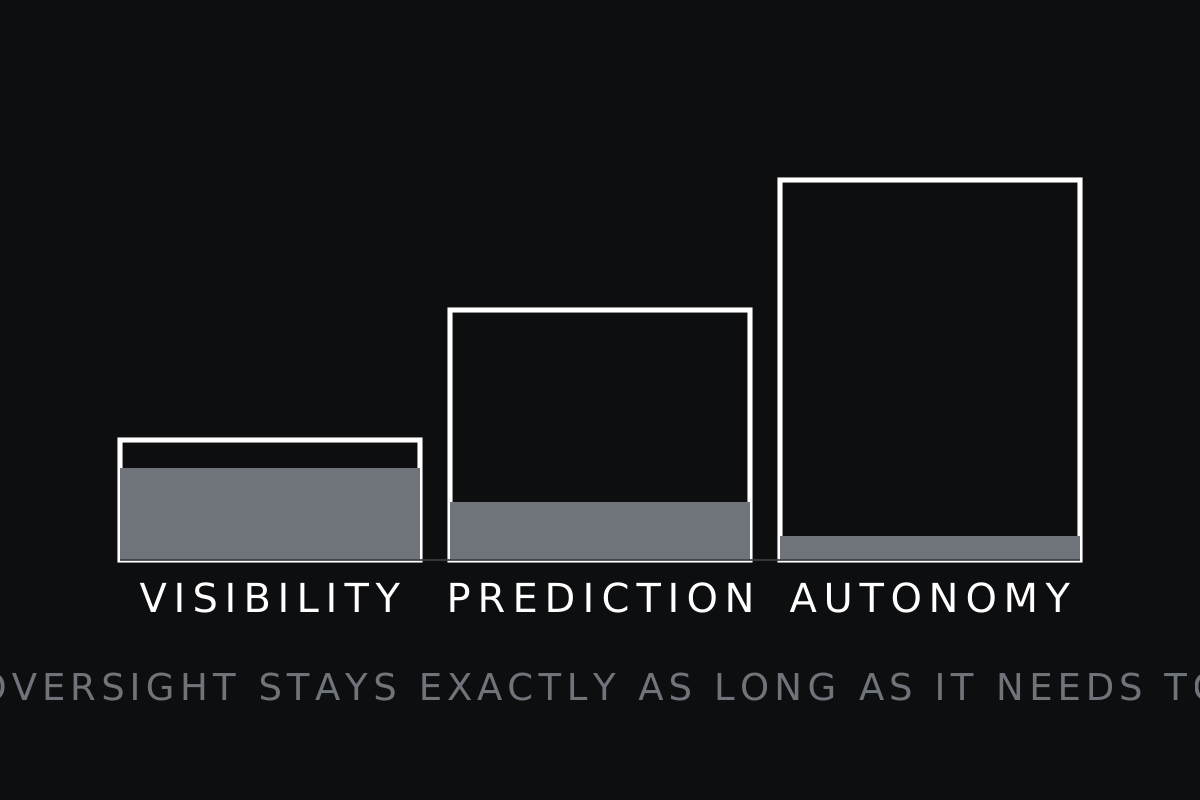
That does not mean removing oversight. It means collapsing the distance between detection and action until a human is approving a decision rather than assembling one from scratch. Governance and human oversight stay in place for exactly as long as they need to and no longer — routine decisions are automated the moment confidence has been earned, not held back out of institutional caution.
Part of how Theralon earns that confidence is by continuously surfacing two mirrored views of the operation, side by side: what is trending toward risk and needs attention, and what is quietly performing well enough to be leveraged elsewhere — spare capacity, underused resources or strong performance that could relieve pressure building somewhere else in the enterprise. Treating "what's going right" with the same rigor as "what's going wrong" is what allows Theralon's recommendations to feel like judgment rather than alarm.
Examples of decisions Theralon can support or automate include: escalating operational risks, creating maintenance work orders, optimising production schedules, reallocating operational resources, updating customer communications, adjusting transport plans, and coordinating operational workflows across multiple enterprise systems.
Earned, however, means something specific. Autonomy is never granted because a model is confident. Every candidate action passes a sequence of gates: reasoning confidence, sufficiency of evidence, sufficiency of calibration, reversibility, and governance authorisation. Failure of any single gate means no autonomous execution — an action can carry 97% predicted effectiveness and still be withheld because it cannot be reversed or has not been properly authorised. These are not weighted into an autonomy score that a strong result elsewhere can outvote.
Autonomy is therefore the execution consequence of trusted reasoning, not a separate agent layer bolted onto the side of the platform. What is executed flows straight back into Operational Memory, where the outcome recalibrates the reasoning that recommended it.
The direction of travel is always toward more autonomy, not less. Automation expands the moment confidence has been earned — never held back for its own sake. Every autonomous action becomes another test of the system’s reasoning, another measured outcome and another piece of operational memory. Over time, the platform moves from assisting decisions, to accelerating them, to executing the decisions that can be trusted to run within clearly defined boundaries.
10Governance, trust and auditability by design
Enterprise-grade intelligence has to be enterprise-grade software. Every mutation to a risk item, model or Principia entity is recorded through a single, unified versioning mechanism, giving a complete, tamper-evident history of what changed, when, and why — not a best-effort log bolted on afterward. Governance is therefore built into the same structures that create intelligence, rather than placed around them as an administrative layer.
This matters because Theralon is not simply observing the enterprise. It can influence decisions, create recommendations, alter operational state through governed actions and, as autonomy expands, execute authorised changes. The platform therefore has to establish not only what it knows, but who is allowed to see it, who is allowed to change it, what authority is required to act, and exactly what happened when an action was taken.
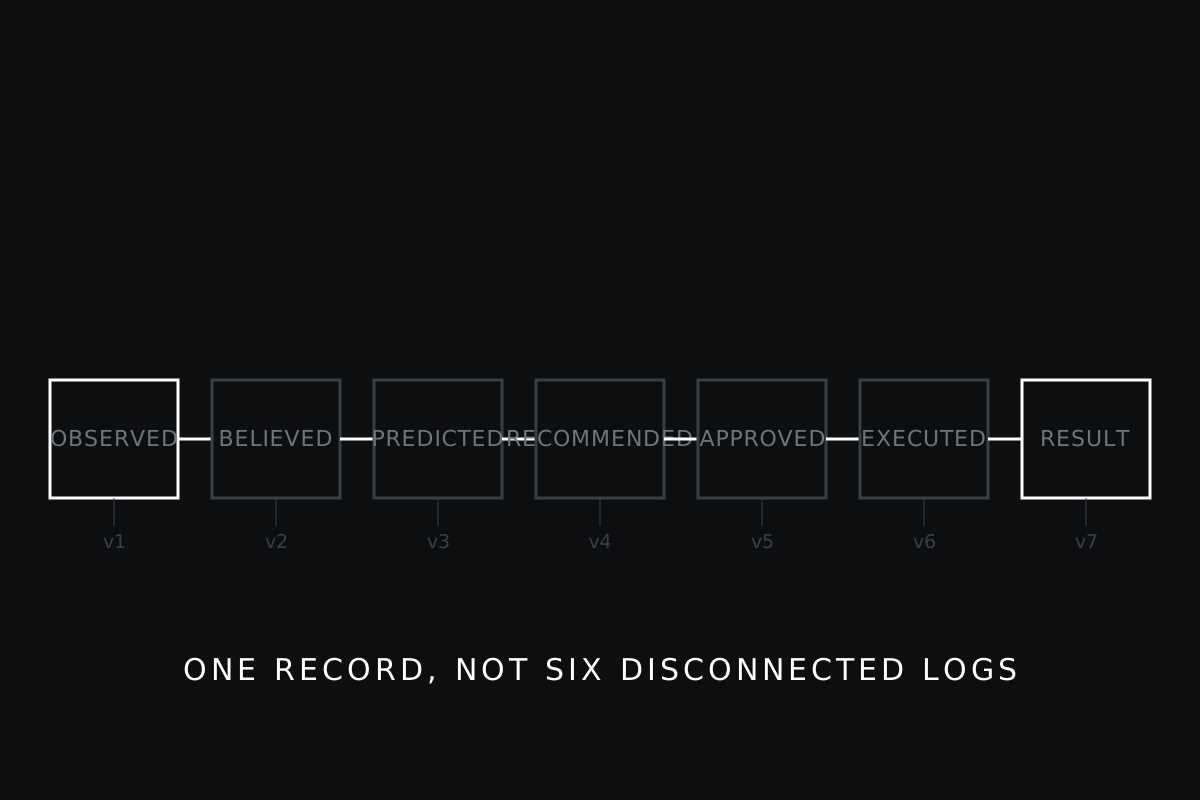
The organisation can see not only what Theralon believes, but how that belief came to exist, what changed it and which authority permitted the resulting action. Facts carry provenance. Models carry versions. Recommendations retain their reasoning chain. Actions retain their approval and execution history. Outcomes return to Operational Memory. The result is a continuous record from observation to decision to result rather than a collection of disconnected logs that only become meaningful when someone manually reconstructs them after the fact.
That same log is what makes the whole network reconstructable at any past date, so an audit is answered from the record itself rather than from someone's recollection of it. An auditor can establish what the Principia contained at a particular moment, which source observations were available, what Theralon believed, what confidence it assigned, which recommendation followed, who approved the action and what happened afterward. Historical state is therefore part of the platform's design, not a separate archival exercise.
Every claim the platform makes carries provenance back to the model version and data that produced it. This extends to conversational answers and generated reports: a different interface does not create a different standard of truth. The evidence supporting a finding remains accessible through the same underlying chain, subject to the same permissions and governance rules. Ask Theralon can therefore make operational intelligence easier to access without making it harder to inspect.
Access is scoped per principal, isolation is enforced per tenant, and deployment region is a first-class, disclosed configuration — the platform warns rather than silently guesses when that hasn't been set. A user should never have to rely on a presentation layer to enforce a boundary that the underlying intelligence layer ignores. Permissions apply to the underlying operational objects and relationships so that the same controls govern dashboards, reasoning, conversational access, reports and actions.
Governance also constrains autonomy. A recommendation can be technically valid and operationally attractive and still be blocked because the action exceeds its authorisation boundary, lacks sufficient evidence, is insufficiently reversible or falls outside the organisation's defined policy. Governance is therefore not a final approval button attached to an otherwise autonomous system. It is part of the decision path from the beginning.
For teams building on top of the platform, an installable SDK and a published, self-describing schema provide direct, typed access to the Principia, risk register and model-card endpoints. This extends the same principles beyond Theralon's own interface: structured access, explicit contracts, versioned behaviour and inspectable provenance rather than undocumented dependencies.
The objective is straightforward. Theralon should be able to move fast without becoming opaque. It should be able to reason broadly without breaking access boundaries. It should be able to act without losing accountability. Trust is not something added once the intelligence is built. It is part of the architecture that makes the intelligence usable in the first place.
11Why Theralon is different
Most enterprise software specialises in a single operational domain. ERP manages business processes. SCADA manages industrial control. WMS manages warehouses. CMMS manages maintenance. TMS manages transport. Theralon understands how they interact.
The broader platforms in this space — Palantir chief among them — are, correctly, general. Palantir's own documented primitives are already broad: ontology, models, actions, scenarios, AI agents, simulation, operational feedback loops. Theralon's position is not that those primitives are unavailable elsewhere, or that Palantir cannot technically be assembled into something like this. It is a different philosophy of product, not a capability claim. Palantir is a platform for constructing operational intelligence. Theralon is an opinionated operational reasoning system that continuously runs the intelligence loop. A general platform asks the customer, in effect, what system would you like to construct. Theralon says: give us the operational reality, and we will continuously determine what is happening, what is changing, what it affects, what you are exposed to, what you should do, and whether that decision worked. Breadth is one strength. Opinionation is another, and it is the one Theralon is built on.
Its competitive advantage is not a single AI model. It is the continuously expanding operational knowledge created by observing relationships across the entire enterprise. Every signal is read in the context of everything it touches rather than in isolation, which is what separates knowing where something is from understanding what it means and what it will cause. Every prediction becomes new knowledge. Every intervention becomes new evidence. Every outcome improves future recommendations.
That improvement is not left to chance. Theralon continuously evaluates the accuracy of its own predictions against what actually happened, and keeps a transparent, plain-language record of when a model was retrained, why, and what changed as a result. Confidence in a recommendation is never asserted — it is earned and shown.
Over time, Theralon develops operational memory — the accumulated understanding of how complex organisations behave, how disruption emerges and which interventions consistently produce the best outcomes. That intelligence compounds. The longer an organisation operates with Theralon, the more valuable the platform becomes.
Operational memory is not an audit log. An audit log answers who changed which field. Operational memory answers why a decision was made, what evidence supported it, what was expected to happen, and what actually happened — held as a connected chain: what we believed, what we predicted, what we recommended, what the organisation decided, what was executed, and what followed. A recommendation to shift 40% of allocation, approved at 25%, executed eleven hours later, where the predicted constraint did occur but the expected cost reduction was overstated by 23%, is a single connected record rather than six disconnected ones.
That structure is what allows the platform to learn from being wrong in a useful way. Not "prediction accuracy was 73%", but "our propagation reasoning consistently overestimates cost avoidance when recovery time exceeds five days" — a conditional statement that changes the next recommendation rather than merely scoring the last one.
The moat this creates is not accumulated data. Data is copyable and frequently purchasable. It is accumulated, validated operational reasoning: the record of which interventions actually worked, under which conditions, for this specific operation. That does not transfer, and it cannot be bought.
12The future of enterprise operations
The next generation of enterprise software will not be defined by better dashboards. Or faster reports. Or more alerts. Those are improvements to visibility. The larger opportunity is to change what enterprise software is capable of doing with the information it already controls: understanding the operation as a connected system, reasoning continuously over its state, and helping the organisation change the outcome rather than merely observe it.
It will be defined by systems capable of understanding operations as they happen, anticipating disruption before it occurs and coordinating decisions across the entire enterprise. The winning systems will not simply tell operators more about the organisation. They will know which changes matter, why they matter, what those changes will cause, where the organisation is exposed, and which action has the highest expected value under the constraints that actually exist.
Every major enterprise will eventually operate with an intelligence layer. The only question is which platform they will trust to become it — which system they will allow to sit above their operational estate, understand how the pieces interact, influence consequential decisions and accumulate the institutional memory required to make the next decision better than the last.
Theralon is being built to answer that question. Not by replacing the software enterprises already depend upon. By giving those systems the intelligence they were never designed to possess. The systems of record remain where they belong. The operational intelligence sits above them, connecting what they know, challenging what they disagree on, projecting what happens next and coordinating what the enterprise should do in response.
Because recording operations is no longer enough. The future belongs to enterprises that understand them — enterprises that can see change before it becomes disruption, understand exposure before it becomes loss, and act before the window for intervention closes.
The Principia gives Theralon a world model. The reasoning loop gives that world model intelligence. Ask Theralon puts that intelligence directly in the hands of the people making decisions. Autonomous operations turns trusted reasoning into action. Operational Memory makes that intelligence compound. Together, they form the foundation of an enterprise that does not simply record what happened, but continuously understands what is happening, what will happen next, and what it can do about it.