
Library — Resilience
Operating through disruption
Storms, closures, supplier failures and sudden surges will happen. What separates operations is how early they see the consequence, and how many options remain when they do.
01The problem
Disruption is described as an event. For an operation, it is a propagation.
A storm, a closed route or a failed supplier is a change in one place. What makes it expensive is the way it moves — through dependencies, buffers and capacity — until it reaches something that cannot absorb it. By the time that effect is visible, most of the ways to soften it have gone.
Resilience therefore depends less on predicting every event than on understanding, continuously, what each part of the operation depends on and how much slack sits in between.
The event is rarely the problem. The problem is how far it travels before anyone sees where it is going.
02How it plays out
A storm is forecast to close a major road corridor for up to three days, starting on Thursday.
An illustrative sequence, not a customer account.
The signal
The forecast arrives as weather, not as an operational event. Most of the systems the operation runs on have no way to read it at all.
What it means
Because the dependencies are already explicit, Theralon can follow the closure forward: which shipments use the corridor, which sites they feed, how much buffer each site holds and when each would run out. Propagation shows two sites absorbing the closure comfortably, a third running short of a critical input by Saturday, and a customer commitment downstream of it at risk on Monday. Exposure collapses dozens of affected shipments into those two concentrations.
What is recommended
Pull Wednesday’s deliveries forward to the exposed site, book alternative routing for the most critical input, and warn the downstream customer early with a revised plan. Operational Memory brings up how a comparable closure unfolded before, and which measures actually helped.
What follows
The storm closes the corridor as forecast. The exposed site rides it out on stock that arrived a day early.
The storm could not be prevented. How far it travelled through the operation could.
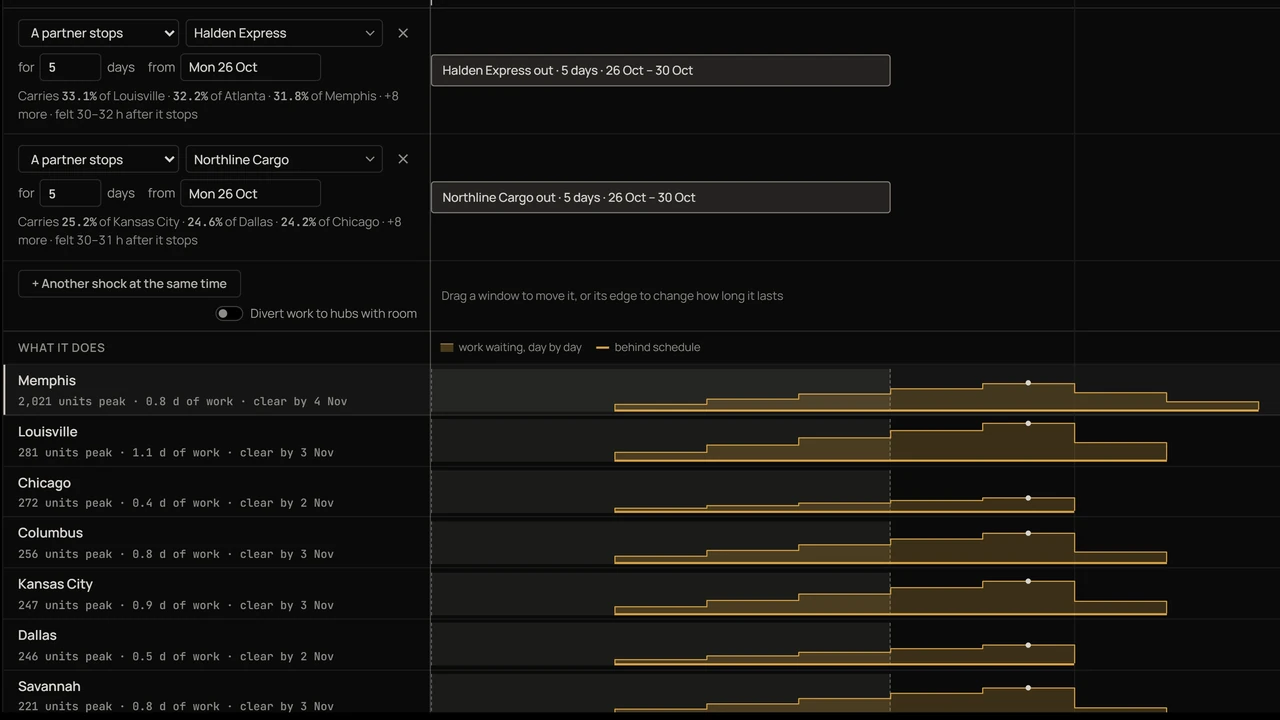
Before the next disruption
We'd show you on Monday what Thursday's closure reaches.
Terra carries the change through your sites, routes and commitments. Vigil counts the exposure once, at its source, and keeps the decision and what followed for the next time.
- Scenarios run before the event
- The options that remain, each with its cost
- What worked last time, on record
A screen from Terra, on synthetic data.
03Where Theralon applies
- 01
Dependencies made explicit
The sites, routes, suppliers and assets that carry the most downstream weight, known before anything goes wrong.
- 02
Following the change
When something changes, its path forward through timing, buffers and substitutes — to where it will land, and when.
- 03
Exposure, consolidated
Many alerts collapsed into the few underlying concentrations that actually matter.
- 04
Scenarios before events
What happens if a supplier fails for seven days, or demand rises sharply — answered against the live model, not a spreadsheet copy of it.
- 05
The options that remain
Interventions weighed for feasibility, reversibility and cost against the whole operation, while there is still time to use them.
- 06
What worked last time
How a comparable disruption unfolded, what was decided, and what actually followed.
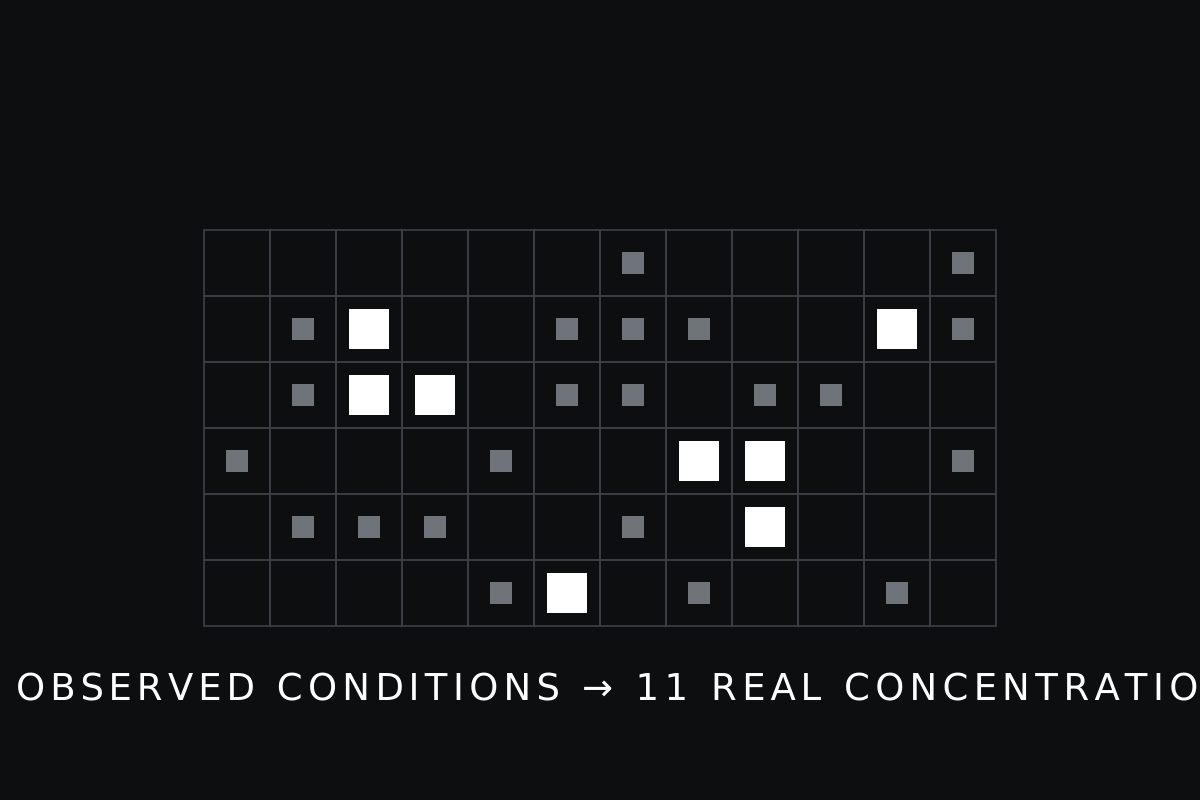
04What changes
Disruption discovered as it lands
Disruption followed as it travels
Hundreds of alerts
A handful of real concentrations
Every crisis handled from scratch
Each one informed by the last
05Under the hood
Propagation models structural and operational dependency, timing, capacity to absorb, substitutability and recovery together. Operational Memory holds what was believed, predicted, recommended, decided and executed — and what followed — as one connected record, so the next disruption is met with evidence rather than recollection.
Two questions
- If a road corridor closed for three days, could you see today which customers and sites it would reach?
- After the last disruption, is what worked written down where the next decision can use it?
Theralon does both. See it on your own operation.
Show us where the operation breaks down. We build around your data, your systems and how you actually operate, at whatever size the operation is. Then compare it with what you run today.
There's no cost while we work with you, for the foreseeable future. You see what the software does on your own operation before it costs you anything.
When it has shown its value there, we agree terms with you, sized to what you run, and nothing becomes a contract until you agree to it.