Library — Industrial base
Below the first tier
Most organisations know their direct suppliers well. The risk that stops production usually sits two or three tiers further down, where nobody is looking.
01The problem
The dependency that stops production is rarely the one on the contract.
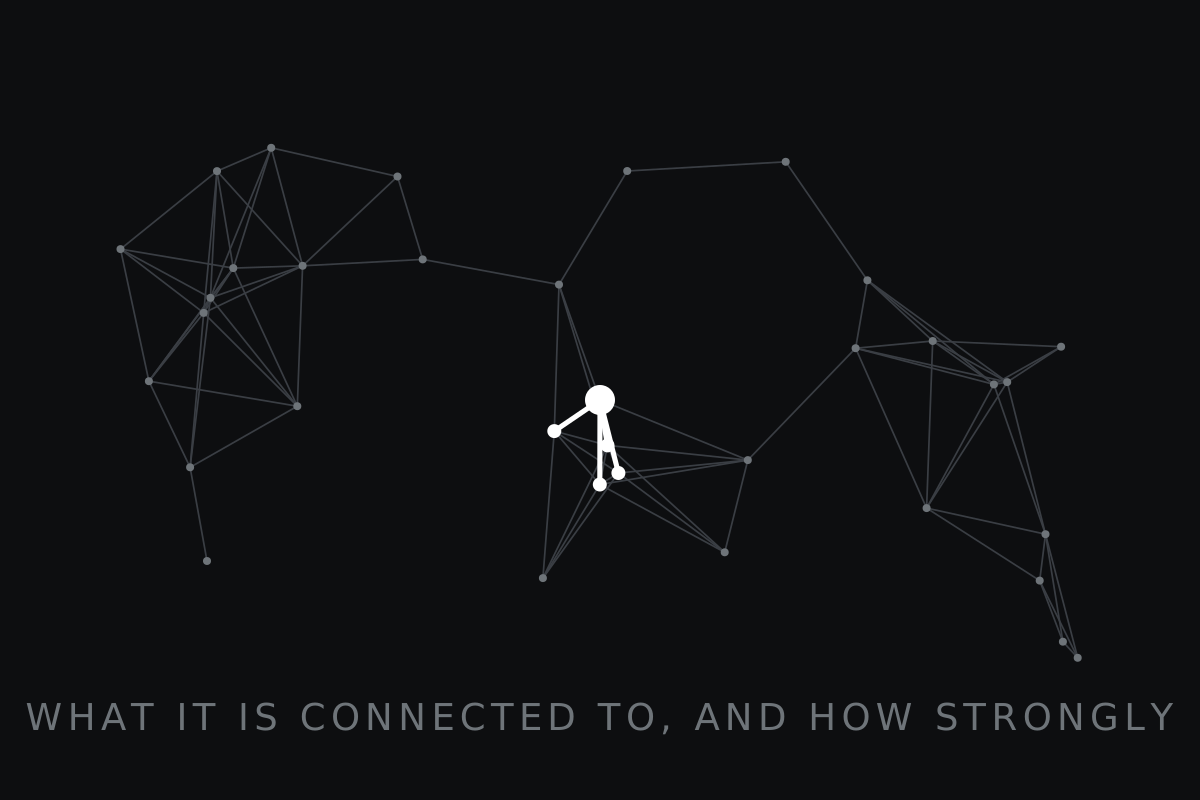
A finished product rests on a supplier network far deeper than any purchasing system records. A first-tier supplier depends on its own suppliers for castings, electronics, coatings and raw material, and those depend on others again. Somewhere in that web there is usually a single facility, a single qualified process or a single source of material that a large share of production quietly relies on.
From the top, that concentration is invisible. Each tier reports its own performance in its own terms, and the dependency surfaces only when it fails — by which point the lead time to qualify an alternative is measured in months.
The risk that halts a line is usually shared by products that were never meant to share anything.
02Where Theralon applies
- 01
Mapping the tiers you can see
The supplier network built from purchasing, receipts, quality records and shipping data, so relationships below the first tier are recorded as structure rather than recalled from memory.
- 02
Finding shared dependencies
Where separate product lines or plants trace back to the same sub-supplier — and that exposure counted once, not several times.
- 03
Weighting by lead time
Each dependency weighed by how long an alternative would take to find and approve, not only by what is spent with it.
- 04
Early signs of strain
Delivery performance, quality escapes and lead-time drift watched for the slow decline that tends to come before a supplier failure.
- 05
What a failure would reach
The orders, lines and deliveries a sub-tier disruption would touch, and when each would feel it.
03What changes
Visibility ends at tier one
Structure recorded as deep as the data reaches
Exposure counted per contract
Exposure consolidated to its common cause
Supplier failure found on arrival
Supplier strain seen in its trend
04Under the hood
Because risk items attach to the entities that actually carry them, three apparently separate supplier risks that share one sub-tier facility are recognised as a single concentration. Every relationship keeps its source and its history, so the network can be reconstructed as it stood on any past date — which matters when the question is not what the network looks like now, but what it looked like when a decision was made.
If this is your operation, we would like to hear about it.
We reply personally. There is no sales queue.
Get in touch →