Library — Ports and maritime
Ports, and the problem with handoffs
A container passes through more organisations in a day at port than in a week at sea. Most of the delay lives in the gaps between them.
01The problem
A port is not one operation. It is a dozen, each holding part of the truth.
Vessel operators, terminals, customs, hauliers, rail operators, forwarders and cargo owners each run their own systems, and each knows something the others need about where a container is and when it will move. The physical work is often quicker than the coordination around it.
When a vessel runs late, the consequences spread in every direction: berth plans shift, yard space tightens, trucks queue, rail slots are lost and inland deliveries slip. Each party sees its own slice and reacts to it. Nobody sees the whole ripple while there is still time to absorb it.
The container rarely waits for the crane. It waits for the information.
02How it plays out
A container vessel is due at the terminal on Tuesday morning. Forty of its boxes are booked onto a rail service that leaves on Wednesday night.
An illustrative sequence, not a customer account.
The signal
The vessel’s arrival moves to Tuesday evening. The berth is still free and the terminal’s plan absorbs it. As far as the terminal is concerned, nothing has gone wrong.
What it means
Theralon carries the delay forward. A later discharge pushes the boxes into a yard block that is already running dense, which slows retrieval; customs release for a dozen of them is still pending; and the rail operator’s cut-off is fixed. Propagation shows twenty-six of the forty boxes missing the train — and, through the bookings behind them, which onward deliveries that puts at risk.
What is recommended
Prioritise discharge and stacking for the rail-bound boxes, chase the outstanding customs releases now rather than on arrival, and give the rail operator early warning on the boxes still likely to miss. Where the terminal and the haulier disagree about a box, the conflict is shown rather than smoothed over, so it is settled by a call instead of discovered at the gate.
What follows
Most of the boxes make the train. The few that do not were known about a day in advance, and their customers heard it from the forwarder rather than on the delivery date.
The crane was never the bottleneck. The time was lost, as it usually is, between organisations that each held part of the answer.
On your terminal
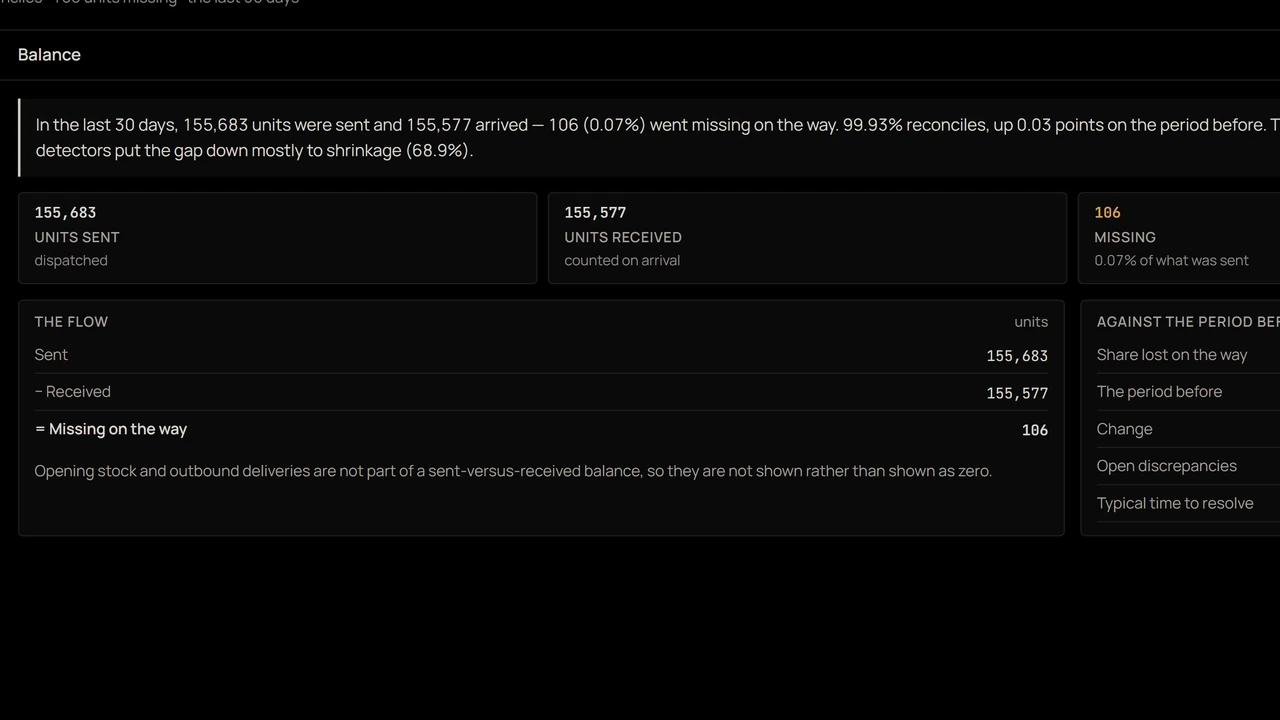
We'd give the terminal one account of the cargo.
Vessel, yard, gate, rail and customs each hold part of the truth. Terra reads them together, so a late vessel arrives as the boxes, connections and free time it will cost, not as a surprise at the gate.
- Delay carried from the berth to rail and road
- Inland connections at risk, named box by box
- Where the sources disagree, and which one is right
A screen from Terra, on synthetic data.
03Where Theralon applies
- 01
One account of the cargo
Vessel schedules, terminal events, shipping notices and haulage bookings reconciled into a single view of where cargo actually is.
- 02
Delay, carried forward
A late arrival projected through berth allocation, yard occupancy and inland connections before the knock-on effects land.
- 03
Dwell and congestion
Dwell times and yard density watched for the gradual build-up that comes before a bottleneck, rather than the moment it becomes one.
- 04
Inland connections at risk
Which onward deliveries depend on a particular vessel, slot or haulier — so the ones at risk are re-planned first.
- 05
Sources that disagree
Conflicting reports kept side by side — the terminal says released, the haulier says not collected — so the discrepancy is investigated rather than silently overwritten.
04What changes
Each party sees its own slice
The ripple visible end to end
Delay noticed when it lands
Delay projected while it can be absorbed
Conflicting records overwritten
Conflicts kept and resolved on evidence
05Under the hood
Theralon reads partner EDI traffic alongside internal systems, so the model reflects what actually moved rather than what was planned. When sources disagree, Operational Truth preserves the conflict and determines the most defensible current state, instead of silently overwriting one system with another.

Two questions
- When a vessel runs late, does anything tell you which boxes will miss their rail connection?
- When the yard, the gate and the line disagree on a box, does anything tell you which one is right?
Terra does both. See it on your terminal.
Show us where the operation breaks down. We build around your data, your systems and how you actually operate, at whatever size the operation is. Then compare it with what you run today.
There's no cost while we work with you, for the foreseeable future. You see what the software does on your own operation before it costs you anything.
When it has shown its value there, we agree terms with you, sized to what you run, and nothing becomes a contract until you agree to it.