Library — Manufacturing
Manufacturing without the scramble
Production plans rest on assumptions about machines, materials and people. The scramble starts when those assumptions change and nobody finds out until the line does.
01The problem
A production schedule is correct on the morning it is written.
Then a machine starts running slightly hot, an inbound delivery slips a day, a quality hold lands on a batch of material and two operators are off. Each change is small, and each lives in a different system. The schedule knows about none of them.
What follows is familiar: expediting, overtime, reshuffled priorities and a production meeting spent reconstructing what changed. The information was available the whole time. It was simply never read together.
The line rarely stops because of one failure. It stops because three small ones were never put side by side.
02How it plays out
A plant’s schedule for the week was agreed on Monday morning. By Tuesday lunchtime, four things have changed.
An illustrative sequence, not a customer account.
The signal
A compressor feeding one line is running a few degrees warmer than usual. An inbound delivery of resin has slipped a day. Quality has put a hold on a batch of components. Two operators on the afternoon shift are off sick. Each change is recorded — in four different systems.
What it means
Theralon reads them as one situation. The resin delay and the quality hold constrain the same two orders, both due Thursday. On its current trajectory, the compressor makes an unplanned stop on that line likely within days. And the staffing gap falls on the shift that would have recovered the lost time.
What is recommended
Bring the compressor’s service forward to tonight’s planned changeover, resequence the line so the held components are not needed until Thursday, and move one experienced operator across from a line with slack. The recommendation shows the effect on every order in the week, not only the two at risk — because expediting one order can starve another.
What follows
Both orders ship on Thursday. Wednesday’s production meeting is about the week ahead, not a reconstruction of what went wrong.
The plant did not need a new schedule. It needed the old one read, continuously, against what was actually happening.
On your plant
We'd keep the schedule true after Monday morning.
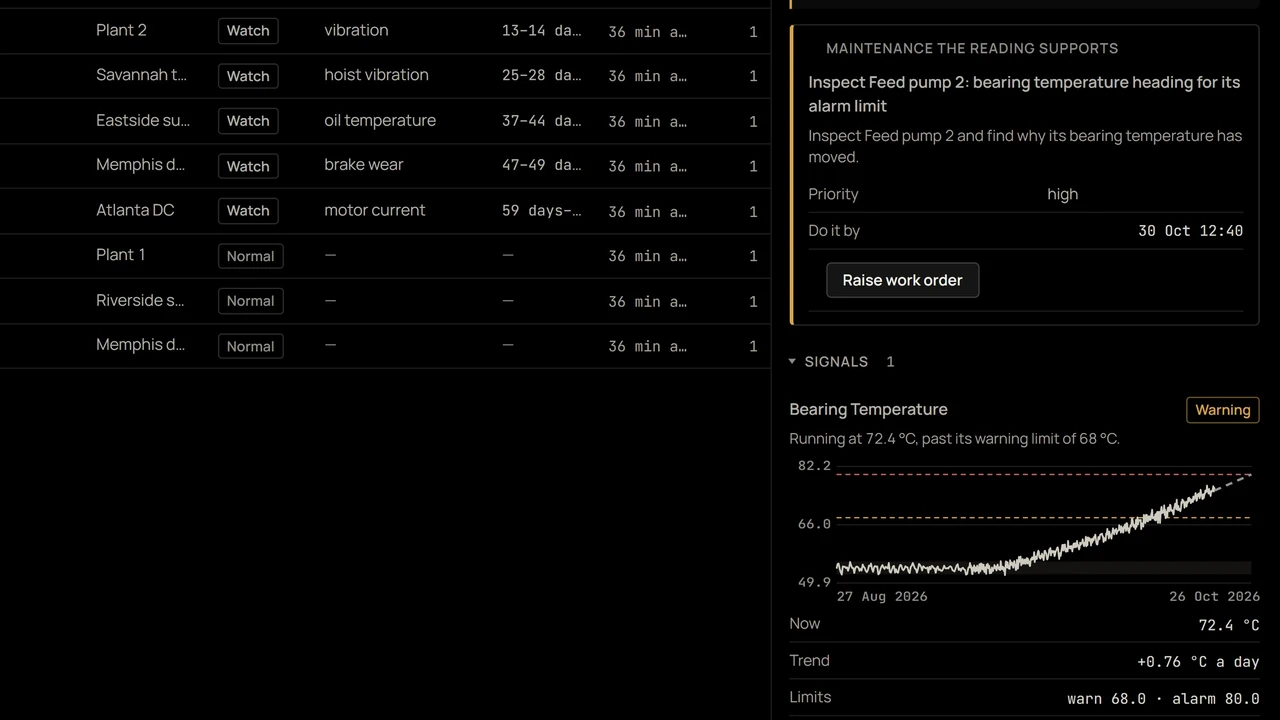
Terra reads the line, maintenance and material together, and shows what Tuesday's changes do to the rest of the week before the scramble starts.
- The schedule checked against what the line is doing
- Maintenance weighed against throughput
- Material shortfalls seen before the line stops
A screen from Terra, on synthetic data.
03Where Theralon applies
- 01
The schedule against reality
Production plans read against live machine condition, material availability and quality status, so the gap between plan and reality is visible before the shift starts.
- 02
Maintenance against throughput
The risk of running an asset weighed against the cost of taking it down, with the effect on orders stated plainly.
- 03
Material constraints
An inbound delay or a quality hold traced to the specific orders and lines it will constrain.
- 04
Early degradation
The first signs of equipment decline read from telemetry, maintenance history and operating conditions.
- 05
Fixes that fit the plant
Each intervention evaluated against the whole plant — because expediting one order can starve another.
04What changes
Changes found when the line stops
Changes read as they happen
Maintenance and production negotiated in a meeting
The trade-off stated with evidence
Expediting by default
Re-planning with time to spare
05Under the hood
Theralon reads MES, CMMS, ERP and plant telemetry as one model, so a vibration trend on a compressor, a delayed inbound material and a quality hold are evaluated in context rather than against static thresholds. Every recommendation carries what is happening and why, the signals behind it, the predicted impact and a stated confidence.
Two questions
- When a machine starts degrading, does anything tell you which orders it will make late?
- When material arrives short, does anything tell you which runs to move first?
Terra does both. See it on your plant.
Show us where the operation breaks down. We build around your data, your systems and how you actually operate, at whatever size the operation is. Then compare it with what you run today.
There's no cost while we work with you, for the foreseeable future. You see what the software does on your own operation before it costs you anything.
When it has shown its value there, we agree terms with you, sized to what you run, and nothing becomes a contract until you agree to it.