Library — Distribution
Distribution centres under pressure
A warehouse runs on a dozen tight constraints at once — docks, labour, space, carrier arrivals — and feels every one of them when volume spikes.
01The problem
Inside a distribution centre, small mismatches compound fast.
Trucks arrive early or late against their appointments. Inbound volume outruns receiving capacity. Pick labour is planned against a forecast that has already moved. One zone fills while another sits half empty. The warehouse management system records all of it faithfully and understands none of it together.
The congestion that results is obvious to everyone on the floor, and to nobody in advance — which is exactly when it could still have been avoided.
Congestion is not a surprise. It is a forecast nobody made.
02How it plays out
A distribution centre expects a busy Friday. Its labour plan was built on Wednesday’s forecast.
An illustrative sequence, not a customer account.
The signal
By Friday morning, three inbound carriers are running early, two are late, and a promotional order has added volume to one pick zone. The warehouse management system records each change faithfully.
What it means
Theralon reads the arrivals against the dock schedule and the receiving team, and sees a backlog forming at the doors by early afternoon. It reads the extra volume against pick capacity in the affected zone and sees that zone running out of space before the evening wave. Through the orders behind both, it shows which customer commitments the combination puts at risk — and which can safely slip.
What is recommended
Resequence two dock appointments, move four pickers from a quiet zone for the afternoon, and divert part of the promotional volume to a neighbouring site with capacity to spare. Each move is stated with what it protects and what it costs.
What follows
The afternoon is busy rather than chaotic. The orders that matter most leave on time, and the ones that slip were chosen rather than stumbled into.
The congestion was never unpredictable. It simply had not been predicted.
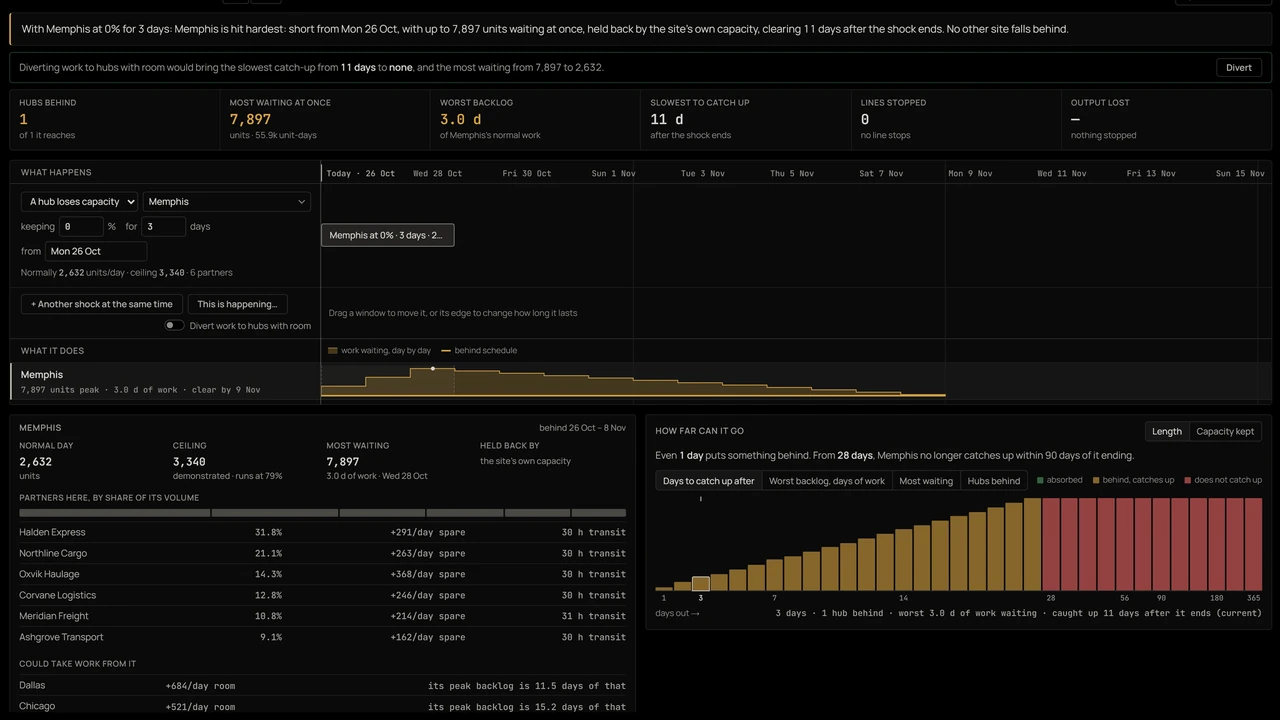
On your DC
We'd show you Thursday's backup on Monday.
Terra reads your inbound appointments, labour plan and dock capacity together, and shows where the week will tighten while there is still time to move a shift or a delivery.
- Docks and labour against inbound, day by day
- The client orders at risk, ranked by what a miss costs
- Moves planned with their effect on every site
A screen from Terra, on synthetic data.
03Where Theralon applies
- 01
Docks and arrivals
Carrier arrival times read against dock schedules and receiving capacity, so a backlog is visible hours before it forms.
- 02
Labour against volume
Pick, pack and receiving workload projected against the people rostered, and gaps filled before they become late orders.
- 03
Space and placement
Occupancy and flow watched zone by zone, with the placements creating avoidable travel and congestion flagged.
- 04
Commitments at risk
The customer orders an inbound delay or a labour shortfall puts at risk, and the order in which to protect them.
- 05
Across the network
Where another site could absorb volume before one building is overwhelmed.
04What changes
Backlog found at the dock
Backlog seen hours ahead
Labour planned to yesterday’s forecast
Labour matched to today’s volume
One building at a time
The network absorbing the spike
05Under the hood
Theralon reads WMS, TMS and ERP events against the Principia, so a late carrier, a short shift and a full zone are evaluated as one situation. Recommendations are weighed against the whole operation — moving inventory can reduce one exposure while creating another, and the platform says so.


Two questions
- When inbound volume starts outrunning the dock, does anything tell you on Monday that Thursday will back up?
- And when it does, which appointments, clients and orders it will hit?
Terra does both. See it on your own operation.
Show us where the operation breaks down. We build around your data, your systems and how you actually operate, at whatever size the operation is. Then compare it with what you run today.
There's no cost while we work with you, for the foreseeable future. You see what the software does on your own operation before it costs you anything.
When it has shown its value there, we agree terms with you, sized to what you run, and nothing becomes a contract until you agree to it.